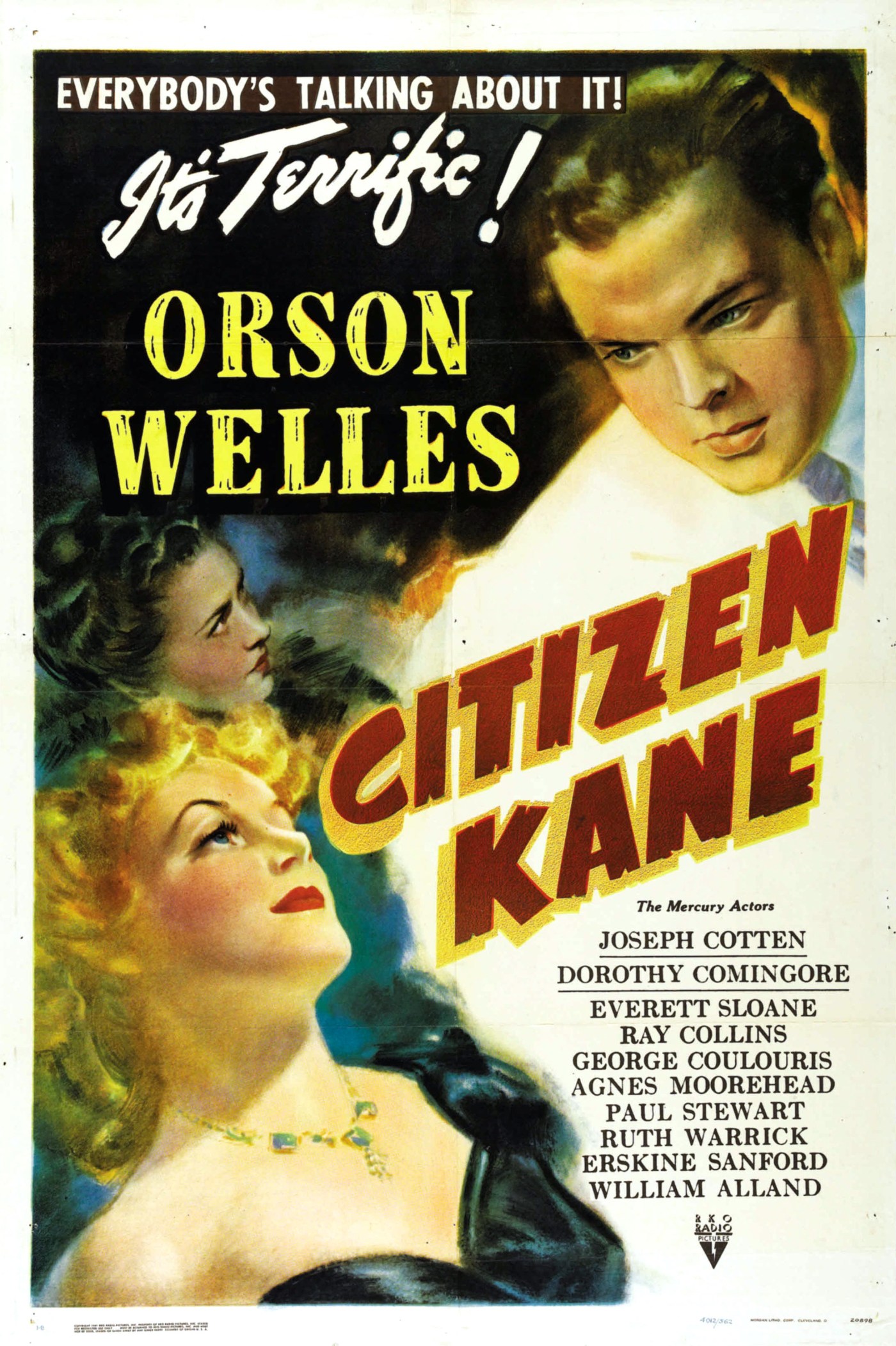
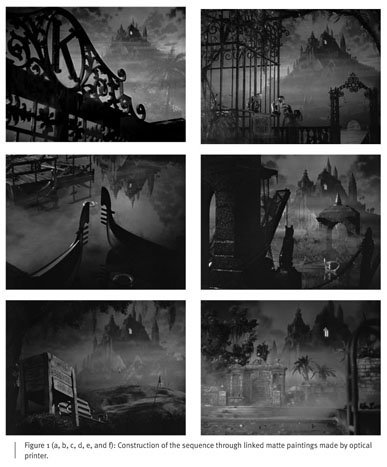
There are the extraordinary off-screen credentials of Orson Welles as co-writer, producer, director, and star at the ripe age of 25. Then, there is the on-screen execution of cinematic artistry that trailblazed everything we use today: matte cutting, boom mic sound, mise en scène, chroma key layering, pristine cinematography, MacGuffin, flashback sequence, wide-angle/deep focus lenses, prop symbolism, and pseudo-documentary style. And, then there’s the story of Citizen Kane (1941) as one of the most meticulously designed dramas ever shot on celluloid to be copied, recycled, and praised thousands of times for decades upon decades.
And then there is the movie.
All the astounding observations above merit Welles and his Citizen Kane a place in earned and celebrated lore and historical relevance, and I am obligated to include this wonder in my Top 50 Reely Bernie Faves list because it was evaluated and appreciated in every single film class I took in college and ranked in the top ten of every single film society from around the world. On a technical level, the production is remarkable and so far ahead of its time, you wonder how audiences first grasped the multidimensional potential of storytelling on film. (Steven Spielberg would be the next to show how, in my opinion.)

Personally, after probably a dozen viewings, I still believe Citizen Kane‘s seamless technical execution is missing an empathetic center. The decline of Orson’s character (presumably newspaper magnate William Randolph Hearst) is a fascinating watch, yes, but the movie offers no insights except that hubris provides no happiness. To this day, it is a struggle for me to feel for old Kane and his yearning for the innocence of “Rosebud.” As if I’m watching a spin-off on Henry F. Potter, the focus on the downfall without a redemption leaves my soul wanting. That’s his choice, I get it, but that’s also my preference. (On a similar note, what else is there to convey in Daniel Plainview besides greed is evil?)
Dare I say Citizen Kane is not a favorite of mine, but my memories of studying it are? Can I acknowledge that every drama we make today wouldn’t have been possible without Citizen Kane, but I’d rather watch The Godfather?
One aspect of the movie no one gives Kane enough credit for is its ethereal ability to feel like a dream turned nightmare. It’s actually quite a haunting movie in the end!
From this Gen X, ex-Blockbuster Video-managing movie blog of humble origins, spot 15 is an appropriate place of homage to the groundbreaker of all groundbreakers, and I look forward to meeting Orson Welles in heaven for him to tell me to move his masterpiece higher.
Citizen Kane is the Ninth Symphony of movies, and broccoli is my favorite vegetable.
Reely Bernie Faves:
5. The Empire Strikes Back (1980)
6. The Godfather Part II (1974)
8. Mad Max 2: The Road Warrior (1981)
10. Nosferatu (1922)
11. Pollock (2000)
12. Kicking and Screaming (1995)
13. Jaws (1975)
14. Fargo (1996)
16. The Blair Witch Project (1999)
20. The Passion of Joan of Arc (1928)
23. King of Kong: A Fistful of Quarters (2007)
24. Raiders of the Lost Ark (1981)
25. Bambi (1942)
26. The Paradise Lost Trilogy (1996-2011)
27. Psycho (1960)
29. Swingers (1996)
30. Terminator 2: Judgment Day (1991)
31. The Diving Bell and the Butterfly (2007)
32. Smoke (1995)
33. Friday the 13th Part 2 (1981)
35. Edward Scissorhands (1990)
37. 1917 (2019)
42. If Beale Street Could Talk (2018)
43. The Greatest Showman (2017)
44. National Lampoon’s Vacation (1983)
45. The Florida Project (2017)
 Reely Bernie
Stayed up all night to watch a trio of Welles’s films: Citizen Kane, Magnificent Ambersons, and Touch of Evil. I was in a delirious fever, so they each seemed a bit more surreal than usual. Kane, and Evil remain amongst my favourites, and improve with every viewing. I agree with your comment on empathy, though, and figure your placement about right. Or maybe up to ten …
LikeLiked by 1 person
Wow! What a wonderful late-night marathon! And, all three of these Welles masterpieces are extraordinary. Citizen Kane will always move around in my Top 20. I have grown more appreciative of its influential power but less attached on a humanistic level. What a fun trip back in time you took last night!
LikeLiked by 1 person
Thanks. That was binge watching that was. Sometimes you just want to drown in it. Keep up the good work!
LikeLiked by 1 person
I know Citizen Kane is one of the greatest movies ever made, but I do need to watch it more than once to truly feel that it is.
LikeLiked by 1 person
Agreed. I’m still not convinced it’s a favorite of mine, but high praise props for all its influences on what we do today!
LikeLiked by 1 person
I have never seen this movie.
LikeLike
I suspct that if you do get to ask Orson anything he’ll be as enigmatic as rosebud was for, almost, the entire movie. 😀
LikeLiked by 1 person
Agreed. I hope heaven humbles him, if anything. If he remains enigmatic, well, then I guess true to form works too 🙂
LikeLike
I agree with what you have to say about Citizen Kane.
The cinematography and photography and technical breakthroughs are superior in every aspect (second to none) but the character of Kane himself is indeed missing an empathetic center.
Perhaps that’s how Welles viewed William Randolph Hearst himself.
The characters in some of Welles’ other 1940s films like The Stranger or The Lady From Shanghai were far more interesting from a literary or dramatic perspective.
Perhaps the trouble with Kane’s character is that he’s always viewed from the perspective of others (who are interviewed by the reporter trying to track down the meaning of Kane’s last word Rosebud).
We get no real sense of what Kane himself is feeling (from the inner perspective of Kane).
And just what it was that made him lose his soul on his way to fame and fortune.
I suppose that’s why the viewer gets a sense of emptiness when it comes to Welles’ depiction of Kane.
We see the outside and the externals only.
We get no real sense of what was going on in Kane’s soul.
LikeLiked by 2 people
I’m glad I’m not alone on this, Dracul Van Helsing. Of course, I give mad props to Citizen Kane, and it deserves trailblaze credit all around. Yet, you make a great point about perspective, and the distance created by objective perception (external hearsay and source material) and directorial interpretation (the intangible artistry that applies subjective to humanize) can be enough to pull away from the “soul” of the main character. I don’t want to give away too much, but if we were to compare biopic historical documentation-to script (playwright)-to film, I can think of no other movie than Amadeus that fleshes out a focal subject from head to toe, flatulence to soul, haha! Milos Forman took so many liberties that it actually heightened the empathy!
LikeLiked by 2 people
Amadeus was a great film.
F. Murray Abraham’s facial expressions were priceless as he Salieri watched Wolfgang in action.
He was able to convey so much through his facial expressions.
There are not too many stars who can do that.
Rose Williams’ portrayal of Charlotte Heywood and Ben Hughes-Thompson’s portrayal of Alexander Colbourne in the British PBS-ITV television series Sanditon – this duo was able to convey so much through their differing facial expressions and even simple hand gestures.
The series also had excellent cinematography and photography and lighting to convey different moods.
LikeLiked by 1 person
The Alexander Colbourne series sounds very intriguing. Where can I find it in the states?
LikeLiked by 1 person
I watched it on PBS.
LikeLiked by 1 person
It’s probably my number 1 movie. It just clicks with me on every single level. Aside from all the technical advances…which still seems ahead of it’s time… I take something else away from it. I feel his yearning for that innocent time before he was thrust into money. I always saw it as he was so ambitious and he wanted to do so much but there wasn’t enough time…he feels like a failure….and now he is old and and wanted… a redo… much like Welles himself when he got old.
I didn’t explain that exactly right…but that is close to my feelings of the character. Orson grew into that character though in real life…that is the sad part.
LikeLiked by 2 people
No, I get you, and I understand your explanation and Orson’s outcome. It might be the typical movie experience arc of when one sees a movie at a certain age and takes away from it something deeply personal, and it evolves from there. Kane isn’t so much that movie for me like the next 14 movies will be on my list, but believe me when I say I can truly empathize your connection to it, and I know you are in a shared viewpoint. I still awe at Kane, but there are others that reflected versions of myself more, and that’s what I look for in movies. Love it, Max. Yes, Welles reflected himself too, didn’t he?
LikeLiked by 1 person
Yes he did … he lived out Kane to a degree sadly.
It’s a movie and probably the first mockumentary ever or one of the first.
LikeLiked by 2 people
No, I think you are right: First mockumentary. Ingenious.
LikeLiked by 1 person
The commercials were cool. “We will sell no wine before its time.”
LikeLiked by 1 person
Yea he talked about them in a book I read…he did it for money to do a film…just rinse and repeat this over and over again. He did that constantly.
LikeLiked by 2 people